Coronavirus and Universal Basic Income:

"A thousand dollars per person should be the baseline."
Universal Basic Income: Elon Musk, Mark Zuckerberg are considering
KALOS: Greek word meaning both "good" and "beautiful"
COSMOS: Greek word meaning both "the world" and "the people"
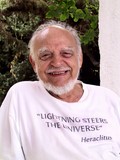
Alfred de Grazia died on July 13th, 2014. KALOS.COsmos is the living website of his political ideas and projects.
Kalos: A General Utopian Strategy
Alfred de Grazia wrote KALOS: What Is To Be Done With Our World? in the 1970s as a possible and visionary plan of action for a determined group to address problems of planetary, local and individual scope the relevance of which is now timelier than ever. A few hours before he died, he was talking with a French friend on the telephone about creating an association to advance the goals of KALOS.
Kalos: a general utopian strategy
Alfred de Grazia, The Divine Succession
Universal Basic Income: the technology is here

A beggar in China collecting alms by way of a QR code...
According to internet consulting firm iResearch, payments made via mobile devices by Chinese consumers last year reached 38 trillion yuan (US$5.5 trillion, HK$43 trillion), more than half the nation’s GDP.
We are certainly well on the path here of the possible implementation of a Universal, Unconditional Basic Income system.
100th birthday of Sebastian de Grazia (1917-2000)
Before going to vote...
You may want to meditate over some of Alfred's thoughts on the Presidency - going back to the Sixties:
There is a dictator only because the bureaucratic state must have a face...
That there is a primitive attractiveness to rule by a single man appears to be a fairly well established anthropological principle...
The people are diverted by the party into accepting the disappearance of direct democracy, with its attractive but impossible promises, while keeping the myth...
The Supreme Court has no longer any shame about reading the Constitution as if its words meant nothing...
Emmanuel Todd
War
No question asked - and nothing asked in return...

Who should inherit the Earth?

by Alfred de Grazia
Alfred de Grazia wrote this "Manifesto" for a preparatory session at the United Nations in view of the Earth Summit in Johannesburg in 2002.
(...)
Every child has an equal interest in the world, therefore an equal right to share in its inheritance.
What should the inheritance be worth?
The inheritance should be composed at the least of a sufficient diet, clean water, clothing and a shelter, an education, security of person and property, freedom to move about in an environment well-maintained, a right to honor, power, liberty of cultural and individual expression.
Kalos: a general utopian strategy
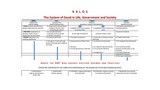
This diagram contains the ideas of KALOS in their shortest and clearest form:
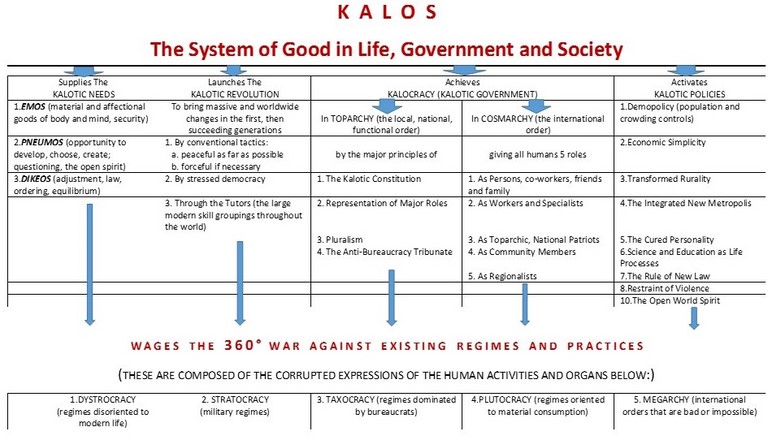
Kalos: Word and Deed
To have Kalocracy requires:
First, an authoritative system of goals: that is called "Kalos." The principal parts of Kalos are the Trilogy of human drives: Emos, Pneumos, and Dikeos, which essentially mean to ingest, to quest, and to adjust.
Second, a group to achieve the ideals rapidly: the Tutors, they shall be called, if they are active. Sympathizers are called Kalists.
Third, a Method of Revolution: Stressed Democracy and Kalokinesis, to bring a) large-scale 360° change b) rapidly c) everywhere.
Fourth, a set of policies (economic, social and moral) that are sufficient, if adopted, to achieve the kalotic goals.
Fifth, constitutional process (or structure) for considering, shaping, and executing the policies. On the world level, this is Cosmarchy. On the group and national level it is Toparchy.
Preface of KALOS,1969
Man sets for himself ever more daring tasks. He hopes to create primitive life forms; he hopes to land on Mars; he hopes to dwell in Antartica; he hopes to eradicate cancers; he hopes to make computers do much of his routine thinking; these hopes and many more, are indeed partially fulfilled.
But the most engrossing task is yet to come. That is world revolution. By "World revolution" we mean a massive beneficial social change around the world in one generation. Such a revolution is nothing else but the imparting of decent order to the present chaos.
Thoughts of the greatest changes should not frighten and freeze mankind. Unmotivated,uncontrolled, and unguided, still man is already changing greatly. All things are in flux, said Heraklites in the ancient beginnings of philosophy; all things are in flux, because all things are full of gods.
Change is of the essence of things; directed change is the greatest challenge of the future. This book is a study of man's troubles, a vision of his possibilites, and a design to supply his needs. It seeks to orient the activist, and to reassure and enthuse the people. Its approach ranges from microscopic to macroscopic; its method is empirical and operational; and its purpose is to prescribe the political tactics of the coming fifty years within our GENERAL UTOPIAN STRATEGY.
(Read more...)
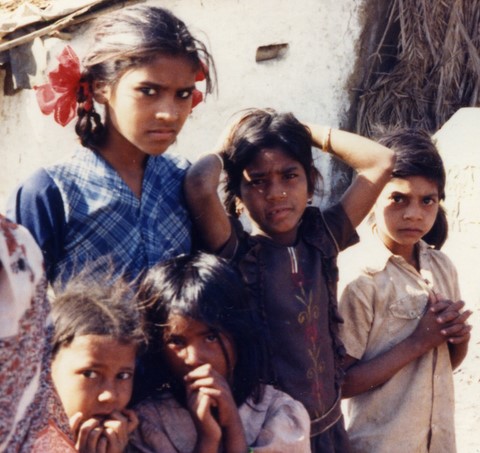
Thirty Years Ago: A Cloud Over Bhopal
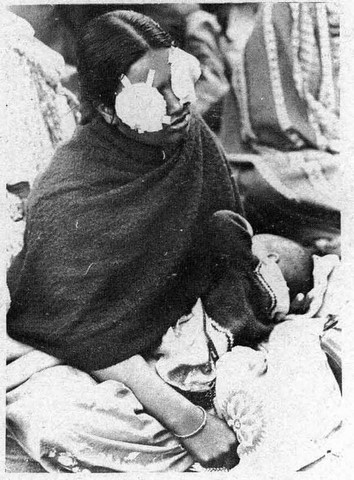
In the night of December 3rd, 1984, a letal gas cloud escaped from the Union Carbide chemical plant in Bhopal, India, and killed 3,000 people. 8,000 more died within the following two weeks. Some 500,000 were exposed and 45,000 sustained injuries. 8,000 more at least have since died of consequences of the exposure. A Cloud Over Bhopal is the fruit of Alfred de Grazia's research and reflection on the spot, the first book written on the disaster, a few weeks after the accident.Go to: A Cloud over Bhopal

There is a constant tendency, among parties as diverse as the poorest of victims and learned American environmentalists, to reduce the Bhopal problem to a particular safety failure for which an assignment of responsibility and quick compensation are the proper resolution. To the contrary, I would say that the meaning of Bhopal needs to be preserved and enlarged. It is a jolting reminder of the gas ovens of Auschwitz, the radiation cloud of Hiroshima, the burned women shirt-makers of a New York City sweatshop whose death began a new chapter in the history of safety and better working conditions. Bhopal can be a watershed in industrial, even in world, history if the victims receive fair treatment and full justice, and if a new code of conduct comes to govern transnational business operations.
Alfred de Grazia, A Cloud Over Bhopal (1985)
Appeal of September 12, 2001
Go to Appeal
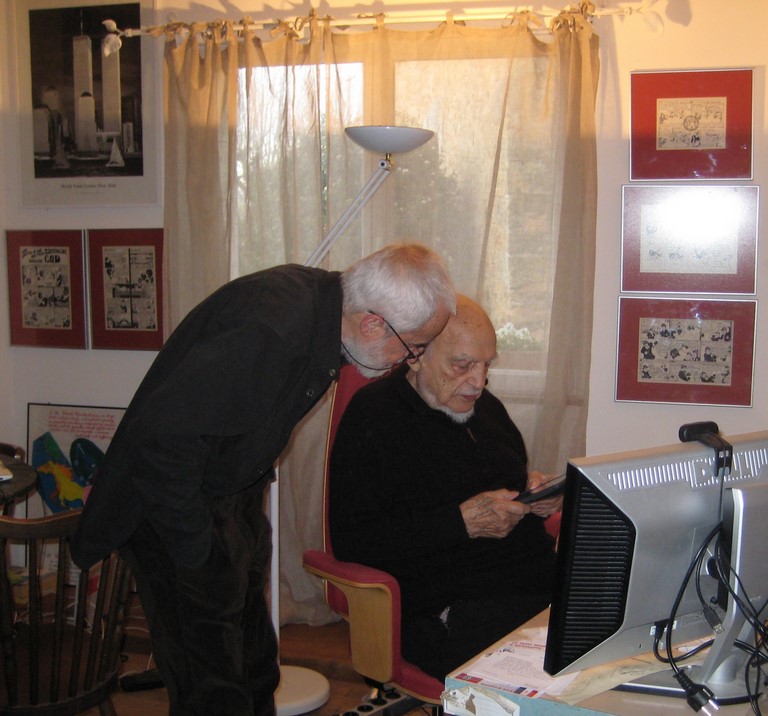
Alfred de Grazia in his study (with R. Stern), picture of World Trade Center in the upper left hand corner.
(Sarthe, Feb. 14, 2014)